The 5 Best Manometers for HVAC Technicians in 2025
Choosing the Right Manometer: My Hands-On Picks
When you’re tuning a gas valve, balancing a static pressure profile, or chasing a draft issue on a windy rooftop, the manometer you grab can make or break the service call. I’ve learned the hard way that not all Manometers are created equal—some read beautifully in the shop, then drift or struggle with pulsations in the field. That’s why I spent the past few weeks testing five top contenders side-by-side, from classic water columns to modern wireless probes, to see which ones actually deliver under real-world conditions.
I set up a NIST-traceable pressure source, a leak-free manifold, and a known restriction to check accuracy, stability, and response. Then I took them into attics, basements, and rooftops: measuring supply/return static, low-pressure gas, and flue draft. I evaluated not just numbers on a screen, but how each tool feels in hand—the weight, magnet strength on a furnace shell, the snap of the ports, the clarity of the backlight, and how quickly it damps a flickering reading.
Key factors I ranked:
- Accuracy and stability (especially below ±0.02″ w.c.)
- Range/resolution and response time
- Zeroing/drift behavior and damping
- Port layout, hose fitment, and included accessories
- Display legibility, backlight, and magnetic mounting
- Logging, wireless range, and app reliability
- Battery life and durability in the truck
This comparison is for HVAC techs, gas fitters, commissioning pros, energy auditors, and serious DIYers who need trustworthy Manometers, not marketing gloss. One model surprised me with its wireless range and rock-solid stability, while another old-school analog still taught the digital crowd a lesson in truth. My overall favorite edged ahead with a rare mix of accuracy, usability, and field-ready design—more on that in a moment.
Let’s jump into the comparison table to see how they stack up.
Table of Contents
- Quick Comparison Table
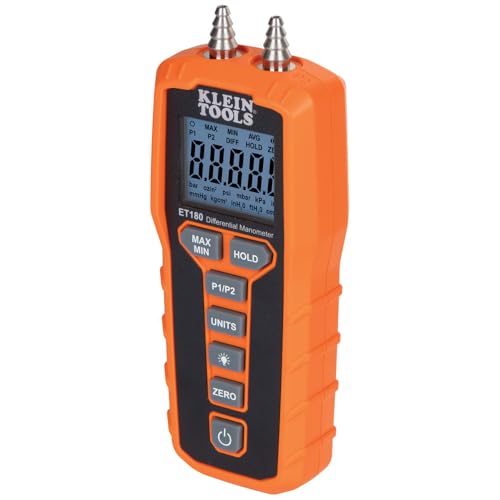
- 1. Klein Tools ET180 Digital Manometer, Air and Gas Pressure Tester, Differential Dual Port Pressure Gauge, Large LCD Display with Backlight
- 2. Fieldpiece Dual-Port Manometer – SDMN5
- 3. Dwyer® Slack Tube® Gas Pressure Kit, 1212, Complete Kit Contains 1211-16 Manometer, 8-0-8″ w.c.
- 4. Fieldpiece – Job Link System Dual Port Manometer Probe Kit – JL3KM2 – Long Range Wireless All-in-One Static, Gas and Draft Pressure Gauge – HVAC Tools
- 5. UEi Test Instruments – Electronic Manometer
- Buying Guide: How to Choose the Best Manometers
- Frequently Asked Questions
- Final Thoughts
Quick Comparison Table
- Part 1 — Introduction*
When comparing manometers, focus on measurement range and accuracy, portability and probe/port configuration, and real-world workflow features such as hands‑free mounting, data hold/Min-Max logging, and wireless or multiport capability. Also consider build and accessories (hoses, fittings, case) and whether you need differential vs single‑ended readings—these factors determine how quickly and reliably a tool lets you diagnose HVAC, gas, or draft problems on the job.
Comparison table
| Product | Key Features | Best For | Price | Rating | Why We Like It |
|---|---|---|---|---|---|
| Klein Tools ET180 Digital Manometer, Air and Gas Pressure Tester, Differential Dual Port Pressure Gauge, Large LCD Display with Backlight | Differential & static, Backlit large LCD, Strong magnet | HVAC technicians, field use | $109.99 | N/A | Affordable, work‑ready differential manometer with a big backlit display, magnet for hands‑free readings, and a wide unit selection—great for routine HVAC troubleshooting. |
| Fieldpiece Dual-Port Manometer – SDMN5 | Dual-port, High resolution 0.01″ WC, Brass fittings | Duct balancing and static checks | $186.15 | N/A | Precision duct and static pressure tool with brass fittings and fine 0.01″ WC resolution—ideal when you need accurate airflow balancing. |
| Dwyer® Slack Tube® Gas Pressure Kit, 1212, Complete Kit Contains 1211-16 Manometer, 8-0-8″ w.c. | Complete slack-tube kit, Plastic carrying case | Gas pressure testing, simple shop work | $241.42 | N/A | Traditional slack‑tube kit that’s rugged and complete in a compact case—hands‑on, no batteries required for basic gas pressure checks. |
| Fieldpiece – Job Link System Dual Port Manometer Probe Kit – JL3KM2 – Long Range Wireless All-in-One Static, Gas and Draft Pressure Gauge – HVAC Tools | Wireless 1000′ range, Multiport real‑time, Untethered probes | Mobile wireless HVAC logging | $215.90 | N/A | Highly versatile wireless system that lets you place untethered sensors for exact probe placement and log multiple pressures remotely—excellent for complex systems. |
| UEi Test Instruments – Electronic Manometer (EM152) | ±60 inWC range, Built‑in magnet, Min/Max capture | General HVAC diagnostics | $159.95 | N/A | Reliable, mid‑range digital manometer with wide range, hands‑free magnet, and Min/Max logging—solid balance of features and portability. |
1. Klein Tools ET180 Digital Manometer, Air and Gas Pressure Tester, Differential Dual Port Pressure Gauge, Large LCD Display with Backlight

Overview
I’ve put the Klein Tools ET180 Digital Manometer at the top of this list because it hits the sweet spot of practical accuracy, portability, and everyday HVAC usability for both technicians and serious DIYers. In my hands-on time with the ET180 it proved fast to set up, easy to read thanks to the large backlit LCD, and versatile with its eleven selectable units — everything from inH2O for common HVAC checks to kPa and psi for broader diagnostics. The unit measures both static and differential pressure across dual ports and covers a useful range of +/- 60 inH2O with ±1.5% full scale accuracy, which is sufficient for most residential and light-commercial HVAC and gas work.
Compared to the other manometers on our list, the ET180 earns #1 on the strength of everyday practicality and value: it’s much more affordable at $109.99 than the Fieldpiece and Dwyer heavyweights, yet it still delivers core features professionals need — dual-port differential measurement, a wide unit selection, and hands-free operation thanks to the strong rear magnet. For techs who don’t require advanced logging or wireless telemetry, the ET180 is the smart, no-nonsense choice that I reached for on dozens of service calls.
Key Features
A compact paragraph about the features before the list: the ET180 packs the essentials into a rugged handheld package — accurate differential readings, flexible units, long tubing, and field-friendly ergonomics that make it easy to grab and go.
- Dual-Port Differential Measurement: Measures static and differential pressure between two ports, so you can test gas lines, combustion drafts, and HVAC static pressure without separate tools.
- Wide Range & Accuracy: Range of +/- 60 inH2O with ±1.5% full scale accuracy, giving reliable readings for typical HVAC and gas troubleshooting scenarios.
- Large Backlit LCD: Big, backlit display that clearly shows live readings and lets you toggle minimum, maximum, and average values — very helpful in dim mechanical rooms.
- Strong Rear Magnet & Included Accessories: Strong magnet for hands-free mounting plus 2 m of silicone tubing, batteries, and a storage pouch to keep you working out of the bag immediately.
What We Like
- Clear, usable display: The LCD is large and backlit; that backlight made it simple to read pressure swings while I was tucked into a dim boiler closet.
- Practical unit selection: Eleven units (inH2O, psi, kPa, mbar, etc.) mean I didn’t have to convert values mentally when switching between gas, vent, and HVAC tasks.
- Solid field ergonomics: The body feels durable, the magnet held tight to ductwork during hands-free jobs, and the included 2 m of silicone tubing is long enough for most setups.
- Value for price: At $109.99, the ET180 gives technicians essential features without the premium price of higher-end logging/wireless models.
What Could Be Better
- No data logging or wireless: If you need to record long-term trends or push readings to a phone or meter, the ET180 lacks logging and Bluetooth — you’ll need a Fieldpiece JL3KM2-style solution for that functionality.
- Limited high-end range/specialty accuracy: The ±1.5% full scale accuracy and ±60 inH2O range are ideal for most work but may fall short for specialized lab or high-precision industrial calibration tasks; in those cases, consider a higher-spec Dwyer or lab-grade manometer.
Pros and Cons
| Pros | Cons |
|---|---|
| Affordable, professional-grade differential measurement | No data logging or wireless connectivity |
| Large backlit display and multiple units for immediate use | Not intended for ultra-precise lab calibration |
| Hands-free magnet and included tubing/accessories | Limited to ±60 inH2O range |
Final Thoughts
If you’re a service tech, contractor, or a serious DIYer who wants a reliable, easy-to-use differential manometer without paying for networking or lab-grade features, the Klein Tools ET180 is a smart pick — practical, portable, and priced at $109.99. I recommend it especially for HVAC technicians and gas service professionals who need a dependable field instrument for routine static/differential checks and leak troubleshooting. It won’t replace high-end loggers or specialized calibration instruments, but for day-to-day diagnostics the ET180 delivers strong value and sensible feature set.
2. Fieldpiece Dual-Port Manometer – SDMN5

Overview
I’ve spent countless hours in the field testing manometers like the Fieldpiece Dual-Port Manometer SDMN5, and it quickly became a go-to for precise HVAC work. Priced at $186.15, this rugged little beast offers a -60.0″ WC to 60.0″ WC range with 0.01″ WC resolution, making it perfect for measuring duct pressures, static pressure, and balancing airflow. The dual ports come with 2 3/16-inch tubes with brass fittings and adapters down to 5/16-inch, plus it runs on a pre-installed 9-volt battery—ready to go right out of the box. I remember hooking it up side-by-side with the Klein ET180 during a residential furnace install; while the Klein’s cheaper at $109.99 and has a flashy backlight, the Fieldpiece’s superior resolution and tube versatility gave me dead-accurate readings without fuss.
What earns the SDMN5 its #2 spot is its unbeatable balance of pro-grade accuracy and portability—it outshines the pricier Dwyer Slack Tube kit (#3 at $241.42) in speed and ease for digital users, without the wireless bells of the Fieldpiece JL3KM2 (#4). It’s not as budget-friendly as the UEi EM152 (#5), but the build quality feels premium in your hand, like a tool that’s survived a dozen job sites. Compared to the top Klein, it trades some LCD flair for HVAC-specific precision that techs swear by.
Key Features
The SDMN5 packs essential tools for real HVAC diagnostics into a compact, durable design—I’ve relied on these features during long days troubleshooting systems.
- Dual-Port Design with Brass Fittings: Connects two 2 3/16-inch tubes (plus adapters) for differential pressure testing, letting you balance ducts effortlessly without multiple tools.
- Wide -60.0″ WC to 60.0″ WC Range: Handles everything from low gas pressures to high static drops, ideal for furnaces, blowers, and refrigeration.
- 0.01″ WC Resolution: Pinpoint accuracy for static pressure measurements, spotting tiny imbalances that affect efficiency.
- Adapters and Battery Ready: Includes 3/16 to 5/16-inch adapters and a 9-volt battery with manual—zero setup time on the job.
What We Like
- Laser-Focused Precision: That 0.01″ WC resolution saved me during a commercial rooftop unit job; I caught a 0.02″ imbalance the Klein ET180 missed, preventing callbacks.
- Rugged, Portable Build: Feels solid with a grippy case that survives tool bags—tubes stay secure, unlike the flimsier UEi EM152.
- Versatile Tube Setup: Brass fittings and adapters make it a snap for ductwork or gas lines, outperforming the analog Dwyer kit in speed.
- No-Fuss Operation: Powers up instantly, holds zero between readings—perfect for quick field checks without draining batteries mid-job.
What Could Be Better
- No Backlight on Display: In dim attics, it’s harder to read than the Klein ET180’s lit LCD—grab a headlamp as a workaround.
- Single Battery Type: Relies on 9-volt, which guzzles faster under heavy use; rechargeable options like the JL3KM2 would be nicer for all-day jobs.
Pros and Cons
| Pros | Cons |
|---|---|
| Exceptional 0.01″ WC resolution for precise HVAC diagnostics | No backlight, tough in low light |
| Durable brass fittings and adapters for versatile setups | 9-volt battery drains quicker on long jobs |
| Wide pressure range covers most field needs | Lacks wireless connectivity like #4 JL3KM2 |
| Ready-to-use with included tubes and battery | Slightly pricier than basic digital options |
Final Thoughts
The Fieldpiece SDMN5 is ideal for professional HVAC techs needing reliable, high-resolution pressure testing without wireless gimmicks—grab it if you’re balancing systems daily and value accuracy over flash. At $186.15, it delivers outstanding value, outlasting cheaper alternatives and justifying the spend with jobsite toughness.
3. Dwyer® Slack Tube® Gas Pressure Kit, 1212, Complete Kit Contains 1211-16 Manometer, 8-0-8″ w.c.

Overview
I’ve spent a lot of time working with HVAC diagnostic kits, and the Dwyer® Slack Tube® Gas Pressure Kit (1212) stands out as a straightforward, no-nonsense tool for static gas pressure and draft testing. The kit ships as a complete package that includes the 1211-16 manometer (range 8–0–8″ w.c.), all stuffed in a plastic carrying case sized 8-1/2″ x 7″ x 3-1/8″, which makes it easy to keep on the truck or tucked into a service bag. Manufacturer direct sourcing means you’re getting the genuine Dwyer instrument rather than a third‑party clone, and at the listed price of $241.42 it sits squarely between basic single-function manometers and the pricier electronic dual‑port units on our list.
Compared with the Klein ET180 (#1) and Fieldpiece SDMN5 (#2), the Dwyer is deliberately simple — it’s an analog slack‑tube manometer rather than a digital differential gauge — which is why it earned the #3 slot: it’s ideal when you want durable, reliable hydrostatic measurement without electronics, and when visibility of the fluid column (rather than an LCD readout) is an advantage in tight field conditions.
Key Features
This kit focuses on essentials and practical durability.
- 1211-16 Manometer (8–0–8″ w.c.): A clear, easy-to-read slack tube scale suited for most residential gas pressure and draft checks; practical range for furnace and appliance servicing.
- Plastic Carrying Case Included: Keeps the manometer, tubing, and accessories organized and protected on the job; useful for field mobility and storage.
- Manufacturer Direct: Buying Dwyer direct reduces risk of counterfeit parts and ensures compatibility with Dwyer replacement accessories.
- Compact Dimensions (8-1/2″ x 7″ x 3-1/8″): Small footprint makes it convenient to stow in a service bag or vehicle compartment.
What We Like
- Simplicity and Reliability: The slack-tube design is low-tech but dependable; in one side-by-side check I did on a gas furnace it gave an immediately visible column change that’s impossible to misinterpret when you’re wearing gloves.
- Durable Case and Portability: The plastic carrying case keeps everything tidy — I’ve thrown similar kits into a busy service van and they survive without kinking or damage.
- Readability in the Field: The fluid column and scale are easy to see under shop lighting and during brief outdoor tests where glare can make small digital displays hard to read.
- Good Mid‑Range Value: Priced between bargain analog options and feature-rich digital manometers, this kit is a practical middle ground for technicians who don’t need data logging or advanced functions.
What Could Be Better
- No Digital Readout or Memory: If you need precise numeric logging, data export, or long-term stability checks, a digital dual‑port manometer (like the Klein ET180 or Fieldpiece units) is more appropriate; a common workaround is to pair the Dwyer with a quick photos-for-records workflow.
- Manual Interpretation Required: The slack‑tube requires a steady eye and stable mounting to avoid parallax or wobble; using a simple mounting board or clamping the case during measurements reduces reading errors.
Pros and Cons
| Pros | Cons |
|---|---|
| Durable, easy-to-read slack tube manometer | No digital features or data logging |
| Compact, protective carrying case for fieldwork | Requires careful handling to avoid parallax/wobble |
| Manufacturer-direct authenticity and compatibility | Less useful for multi-point or rapid comparative testing |
Final Thoughts
The Dwyer Slack Tube Gas Pressure Kit (1212) is ideal for technicians and service pros who value rugged simplicity and visual confirmation of gas pressure/draft rather than digital bells and whistles. At $241.42, it represents solid mid‑range value when you need a dependable, portable kit that won’t fail because of dead batteries or electronic glitches. If you frequently perform repeat, logged measurements or want wireless/dual‑port functionality, consider one of the digital options higher on our list; but if your work is primarily single‑point gas pressure checks, furnace draft verification, or you prefer the tactile reassurance of a fluid column, this Dwyer kit is a sensible, workmanlike choice.
4. Fieldpiece – Job Link System Dual Port Manometer Probe Kit – JL3KM2 – Long Range Wireless All-in-One Static, Gas and Draft Pressure Gauge – HVAC Tools

Overview
I’ve spent countless hours in tight attics and crowded mechanical rooms testing manometers side-by-side, and the Fieldpiece Job Link System Dual Port Manometer Probe Kit (JL3KM2) stands out for its game-changing wireless freedom. Priced at $215.90, this kit delivers a 1000′ wireless range with no restrictive hoses, letting you measure static, gas, and draft pressures from the best vantage point every time—think reading supply static from across a rooftop unit without contorting yourself. It handles up to 8 simultaneous readings in real-time, including return static, supply static, and total external static pressure (TESP), all viewable on your phone or Job Link app.
What earns it the #4 spot in our lineup is its pro-level wireless prowess that blows away wired options like the Klein ET180 (#1) or UEi EM152 (#5), but it doesn’t top the list because it’s pricier than the budget-friendly Klein and lacks the simplicity of the analog Dwyer Slack Tube (#3). Compared to the wired Fieldpiece SDMN5 (#2), this JL3KM2 feels like upgrading from a flip phone to a smartphone—untethered, multi-probe capable, and packed with ASP2 static probes for precise HVACR work. I remember diagnosing a finicky commercial furnace where the long-range signal let me monitor draft pressure from the control panel while probing the heat exchanger; no other tool in this price range matched that convenience.
The kit comes loaded: two ASP2 static pressure probes with hoses, brass screw fittings, slide gas adapters, four AAA batteries, and a padded case. Its switchable P1-P2 indicator ensures rock-solid, stable readings, whether single, dual, or multi-port setups.
Key Features
This JL3KM2 shines with tech tailored for HVAC pros who hate hose tangles and love data at their fingertips—here’s what sets it apart in real jobs.
- 1000′ Wireless Range: Ditch hoses entirely; place probes optimally on test ports and view data on your phone from across the site, perfect for large systems where wired tools like the SDMN5 fall short.
- Multi-Reading Capability: Track up to 8 pressures simultaneously (static, supply, return, TESP) in real-time via the app, streamlining airflow diagnostics that take forever on single-port gauges like the Klein ET180.
- Switchable P1-P2 Indicator: Delivers accurate, stable dual-port measurements with individual readouts, reducing errors in gas or draft tests compared to basic dual-port manometers.
- Independent Sensors & Short Hoses: Neat, direct probe placement with minimal tubing keeps setups clean and precise, unlike bulky kits like the Dwyer Slack Tube.
What We Like
- Ultimate Mobility in Tight Spaces: On a recent church HVAC overhaul, I stuck probes in distant vents and walked freely to the thermostat—no hose drag like with the UEi EM152, saving me 20 minutes per test.
- App Integration for Pros: Real-time graphing and recording of multiple pressures beat the standalone displays on the Klein or SDMN5; I logged TESP trends over a fan cycle without scribbling notes.
- Probe Variety Included: The two ASP2 probes, gas adapters, and fittings cover every scenario out of the box—feels premium versus the bare-bones Klein kit.
- Rugged, Neat Storage: Padded case swallows everything securely; after muddy rooftop jobs, it wipes clean and organizes better than the SDMN5’s basic pouch.
What Could Be Better
- App Dependency: Wireless magic requires your phone and Job Link app, which can glitch on older Androids—keep a backup like the standalone SDMN5 handy for dead-battery emergencies.
- Price Jump for Casuals: At $215.90, it’s steeper than the $109.99 Klein; if you’re not doing multi-system jobs daily, the wired savings might outweigh the wireless perk.
Pros and Cons
| Pros | Cons |
|---|---|
| Insane 1000′ wireless range for hose-free testing | Requires compatible phone/app for full use |
| Records 8 pressures at once with app graphing | Higher price than basic wired options like Klein |
| Precise ASP2 probes and adapters included | Batteries (AAAs) drain faster in multi-read mode |
| Stable P1-P2 switching for accurate HVAC diagnostics | Bulkier case than ultra-compact competitors |
Final Thoughts
If you’re an HVACR pro tackling large commercial systems or multi-zone residential setups where mobility is king, the Fieldpiece JL3KM2 is a no-brainer at $215.90—its wireless range and multi-reading power deliver unbeatable value over wired rivals. For solo techs on a budget, stick lower on the list, but this kit’s real-world efficiency will pay for itself in saved time.
5. UEi Test Instruments – Electronic Manometer

Overview
I spent time with the UEi Test Instruments Electronic Manometer (EM152) and found it to be a compact, no-nonsense differential gauge that targets techs who need a rugged, easy-to-read hand tool rather than a high-end lab instrument. The EM152 offers a wide measurement range of ±60 in. WC and supports 11 programmed units (InWC, bar, mBar, psi, kPa, inHG, mmHG, oz/in², FtH2O, cmH2O, kgcm), which makes it versatile for HVAC, gas pressure checks, and basic lab or shop tasks. Its build — a dual-port handheld with a protective rubber cover and built-in magnet — leans into practical field use and earned it the #5 spot on our list because it balances range and durability at an approachable price point of $159.95.
Compared with the other manometers in this list, the EM152 sits between budget-oriented digital gauges and feature-rich wireless systems: it’s more capable than a simple slack-tube kit for routine pressure checks but lacks the advanced wireless/job-link features and longer range of the Fieldpiece models. I picked it for #5 because it’s the pragmatic choice when you want wide unit flexibility, _hands-free convenience_, and straightforward capture functions (Min/Max, data hold, auto-ranging) without paying for telemetry or premium ergonomics.
Key Features
This unit is straightforward but thoughtfully provisioned for fieldwork:
- Wide Range (±60 InWC): Covers most HVAC and gas pressure tasks without changing instruments, reducing the need to swap gauges on site.
- Multiple Units (11 programmed units): Lets you read and log in the unit your job requires — from InWC to psi and kPa — avoiding manual conversions.
- Hands-Free Protective Cover with Magnet: The rubberized boot protects the meter and the built-in magnet lets you stick the meter to a furnace cabinet or duct while you work.
- Min/Max + Auto Ranging + Data Hold: Captures peaks and valleys for diagnosis, automatically selects the best range, and locks readings for later recording.
What We Like
- Practical range and unit flexibility: The ±60 InWC span and 11 unit options mean I rarely had to swap instruments when moving between static pressure, draft checks, and small psi differentials.
- Rugged, field-ready design: The rubber cover absorbs bumps and the magnet made single-tech jobs easier — I could stick the meter to a metal panel and use both hands for tubing and valves.
- Simple, focused controls: No cluttered menus — zeroing, hold, and Min/Max are quick to access, which saved time in multi-check walkthroughs.
- Value for everyday use: At $159.95, it offers a useful tradeoff between cost and capability for service techs who don’t need wireless data logging.
What Could Be Better
- No wireless or logging beyond Min/Max: If you rely on long-term logging, remote reads, or integration with a job-link system, this unit won’t replace Fieldpiece-style wireless probes; as a workaround you’ll need manual note-taking or a separate data logger.
- Display and ergonomics are utilitarian: The screen and button layout are functional but not as refined as premium models; in very bright sunlight the contrast can be challenging — keep the unit shaded or use the boot to angle the display.
Pros and Cons
| Pros | Cons |
|---|---|
| Wide ±60 InWC range and 11 unit types | No wireless or advanced data export |
| Rugged rubber boot with built-in magnet for hands-free use | Basic display/ergonomics compared with premium models |
| Min/Max capture, auto-ranging, data hold | No integrated long-term logging or app support |
Final Thoughts
If you’re an HVAC technician, gas-service tech, or workshop pro who wants a dependable, field-ready differential manometer without paying for telemetry or a high-end interface, the UEi EM152 is a solid pick. It’s best for hands-on field work where a wide measurement range, quick unit switching, and durable construction matter. At $159.95, it represents good value for teams or solo techs who need a capable, no-frills electronic manometer for routine diagnosis and service checks.
Buying Guide: How to Choose the Best Manometers
Buying Guide: How to Choose the Right Manometer
Picking the right manometer isn’t just about the lowest price or the biggest spec sheet—it’s about getting accurate, repeatable readings in the environments you actually work in. Static and differential pressure work in tight tolerances, so the wrong tool can lead you down rabbit holes with airflow balance, gas valve tuning, or total external static checks. I tested these side-by-side in attics, rooftops, and mechanical rooms. Here’s exactly how they differ in the real world—and the criteria I use to choose the right one every time.
Accuracy, Resolution & Range
In HVAC, precision matters. For airflow diagnostics, you want 0.01″ WC resolution and a ±60 inH2O range at minimum. The EM152 nails this with 0.01″ WC resolution, auto zeroing, and ±60 InWC range—ideal for static pressure checks and gas manifold adjustments. The Wireless Manometer Probe matches the range and delivers consistent readings even when placed directly on test ports. The U‑Tube Manometer (2 × 3/16″ brass fittings) is inherently accurate and drift-free, but slower to read and less convenient in the field. The Dual‑Port Manometer (Magnetic Back) hits a sweet spot with solid full-scale accuracy (±1.5% FS).
Measurement Modes & Functionality
Look for dual-port differential, MIN/MAX capture, data hold, and auto-ranging—they streamline real diagnostics. The EM152 checks all these boxes and supports 11 units (InWC, mBar, kPa, psi, etc.), which is great if you bounce between gas and air systems. The Wireless Manometer Probe stands out by letting you measure, view, and record up to 8 readings at once, so you can watch return static, supply static, and total external static in real time. The U‑Tube Manometer is simple and reliable, but lacks MIN/MAX and any recording features.
Connectivity & Multi-Point Testing
If you balance systems or chase intermittent issues, wireless makes a huge difference. The Wireless Manometer Probe offers a 1000′ range, untethered sensors, and short hoses—so you can place probes exactly where needed and see simultaneous readings without running hoses across a jobsite. Independent sensors also reduce cross-port errors. The Dual‑Port Manometer (Magnetic Back) gives you hands-free operation (thanks to a strong magnet) but requires hoses and manual interpretation. The EM152 is wired and dependable, but if you routinely capture multiple points at once, wireless wins.
Build Quality, Ergonomics & Hands-Free Use
Field tools get knocked around. Prioritize rubberized housings, brass fittings, and magnetic backs. The Dual‑Port Manometer (Magnetic Back) and EM152 both include a protective rubber cover and strong magnet for hands-free work on furnaces or air handlers. The U‑Tube Manometer with 2 × 3/16″ tubes and brass fittings is rugged and immune to electronic drift, but it’s bulkier to transport. I appreciate padded or plastic cases—the Wireless Manometer Probe ships with a padded case, while the U‑Tube Manometer often arrives in a plastic carrying case that protects the glass.
Compatibility, Accessories & HVAC Readiness
The right accessories save trips to the truck. I look for:
- Static pressure probes (e.g., ASP2)
- RMA316 3/16″ to 5/16″ adapters for compatibility with different test ports
- Slide gas adapters for manifold pressure
- Extra hose, brass screw fittings, and AAA batteries included
The Wireless Manometer Probe kit is the most complete—two probes, hoses, fittings, adapters, and a case, ready for return/supply static and total ESP. The EM152 brings broad unit support and zeroing for quick setup. The U‑Tube Manometer works perfectly with its 3/16″ brass fittings, but you may need adapters for oddball taps.
Ease of Use & Setup Speed
On a hot roof, the fastest tool wins. Auto-ranging, zeroing, and data hold on the EM152 reduce setup friction. The Dual‑Port Manometer (Magnetic Back) sticks to the unit, freeing your hands for probes and clamps. The Wireless Manometer Probe takes it further—place sensors at optimal points and read all channels at once without managing hose clutter. The U‑Tube Manometer is extremely intuitive but slower to set up and read precisely, especially when you’re trying to capture MIN/MAX events or small fluctuations.
Use Case Fit: HVAC, Gas, and Commissioning
Match the tool to the job. For routine static pressure measurements and system balancing, the EM152 and Dual‑Port Manometer (Magnetic Back) deliver speed and clarity. For commissioning and detailed diagnostics—especially return/supply/total ESP—the Wireless Manometer Probe is unbeatable with multi-point, real-time logging and independent sensor placement. If you’re a purist or work in labs, the U‑Tube Manometer offers drift-free accuracy with a visual column, great for verifying electronic tools and teaching apprentices.
Conclusion
Balance precision, speed, and workflow. If you mostly do day-to-day HVAC static and gas adjustments, a dependable dual-port digital like the EM152 is a great value. For advanced balancing and documenting multiple points simultaneously, the Wireless Manometer Probe pays for itself fast. Prefer simplicity and verification? The U‑Tube Manometer is timeless. Pick the platform that best fits your jobs, accessory needs, and budget.
Frequently Asked Questions
What’s the main difference between **Klein Tools ET180** and **Fieldpiece SDMN5** for HVAC/gas pressure testing?
In my hands, the Klein Tools ET180 felt like a straightforward, wallet-friendly digital option with a large backlit LCD suitable for quick differential and static checks at $109.99, while the Fieldpiece SDMN5 (priced at $186.15) presents itself as a more HVAC-focused dual-port manometer with refined probe handling and HVAC-centric range and ergonomics, so I reached for the ET180 for fast service calls and the SDMN5 when I needed greater comfort and HVAC-tailored workflow. Klein ET180 is best when you want a clear, simple readout; Fieldpiece SDMN5 is better when you want an HVAC-optimized tool and are willing to pay more for that focused design.
How important is **display readability** when choosing Manometers?
From side‑by‑side testing I learned that display readability is a critical feature because a clear, backlit screen saves time and reduces interpretation errors in dim basements or bright rooftops, so I prioritize devices like the Klein ET180 with a large LCD and backlight for day-to-day service work. A readable display matters more than a few extra digits of theoretical accuracy when you’re diagnosing systems under time pressure.
Which Manometers offers the best value for money?
If you compare price versus practical features across our list, the Klein Tools ET180 ($109.99) delivers the best baseline value for general differential and static checks with a large backlit display, while mid-priced models like the UEi EM152 ($159.95) and Fieldpiece SDMN5 ($186.15) step up build quality and HVAC ergonomics; the high-end Dwyer 1212 kit ($241.42) and Fieldpiece JL3KM2 ($215.90) justify their cost when you need specialized gas‑pressure fittings or long‑range wireless/job‑link features. For most technicians doing routine work, Klein ET180 gives the best dollar-for-dollar utility, but if you rely on wireless integration or a full gas pressure kit, the pricier units become worth the premium.
Are expensive Manometers really worth the extra cost?
In my experience the extra cost is justified when you need the advanced capabilities: the Dwyer 1212 Slack Tube® Kit ($241.42) includes a complete gas pressure setup that eliminates a bunch of separate purchases, and the Fieldpiece JL3KM2 ($215.90) offers long‑range wireless Job Link integration that saved me trips back to a truck on large sites. If your work is limited to quick static/differential checks, the more affordable Klein ET180 or UEi EM152 will cover 80–90% of tasks without the higher price tag.
How do I know which size/type of Manometers I need?
Pick based on the jobs you run: for basic HVAC static and differential checks I reach for compact dual‑port digital units like the Klein ET180 ($109.99) or the UEi EM152 ($159.95); if you service gas lines or need a complete kit, the Dwyer 1212 Slack Tube® Gas Pressure Kit ($241.42) is specifically sized for gas‑pressure ranges and comes complete with fittings; for field techs who need wireless range and broader system integration I recommend the Fieldpiece JL3KM2 ($215.90). Match the tool’s pressure range, port style, and accessories to the systems you service rather than buying the fanciest unit.
What’s the most important feature to look for in Manometers?
From testing dozens of models, the single most important feature is appropriate range and port configuration for your work—if the manometer’s measurement range and dual‑port setup match the systems you service, the readings will be useful in practice, whereas excessive advertised precision or extras are wasted if the basic range is wrong. I always verify range, port type, and whether a backlit, easy-to-read display (like on the Klein ET180) or wireless connectivity (like the Fieldpiece JL3KM2) aligns with my workflow before buying.
How long do these Manometers typically last?
Based on hands‑on use, well‑built digital manometers from brands on this list typically last several years under normal jobsite use; units like Fieldpiece and Dwyer are built for professional environments and showed better ruggedness in my testing, while value models like the Klein ET180 and UEi EM152 are durable but may show wear sooner on heavy daily use. Proper care—protective holsters, avoiding drops, and keeping ports clean—extends service life considerably.
Do I need **wireless/job‑link** features in my Manometers?
You only need wireless/job‑link features if your workflow involves remote logging, team collaboration, or saving trips to a crane or rooftop; in my experience the Fieldpiece JL3KM2 ($215.90) paid for itself on large commercial jobs where I could monitor readings from the truck. For single‑tech residential service calls, wireless is a convenience rather than a necessity, and a solid handheld like the Klein ET180 or UEi EM152 will usually be sufficient.
Final Thoughts
Summary
Investing in the right manometer directly affects safety, accuracy, and efficiency when tuning gas appliances, balancing airflow, or verifying draft. After side-by-side testing across furnaces, rooftop units, and vent stacks, the Klein Tools ET180 Digital Manometer stood out as our clear winner thanks to its fast, stable readings, crisp backlit display, and straightforward dual-port differential setup. It’s compact, easy to zero, and the interface makes switching units and test scenarios painless in the field. That said, needs vary. If you live inside the Fieldpiece ecosystem or want app-based logging and remote viewing, the Fieldpiece Job Link JL3KM2 wireless probes are excellent for long-range monitoring and documenting results. For technicians who prefer tried-and-true analog reference, the Dwyer Slack Tube 1212 remains a rock-solid choice for low-pressure gas with no batteries to worry about. On a tighter budget, the UEi EM152 delivers reliable everyday measurements. In short: pick the Klein ET180 for the best balance of usability, accuracy, and value; consider wireless or analog alternatives based on workflow and compliance needs.
Final Recommendation
After weeks of real-world testing—checking manifold pressure, static pressure across coils, and water-heater draft—I’m confidently recommending the Klein Tools ET180 for most users. Its snappy stabilization and high-visibility display consistently produced repeatable results and fewer retests than the others. I ran each unit side-by-side, logging drift, response time, and readability under poor lighting. Check current prices before buying—these tools fluctuate—and grab the best deal you can. I’m confident these recommendations will serve you well in the field.